HelpHelpProperties and tenancies
Moving in and out, and settling the deposit
Checklists both sides sign off, the details the law asks to be on record, and deposit deductions the tenant answers one by one.
- Reviewed
- Read
- 5 min
Open the property, then Tenancy. Moving in holds the deposit, Right to Rent and the move-in list. Notice and moving out holds the tenant's notice to leave, the move-out list and the deposit settlement. The written statement and documents to sign are under Agreement and documents. Tenants see the same lists under Safety and Leaving in their portal.
Who this is for: letting agencies and landlords.
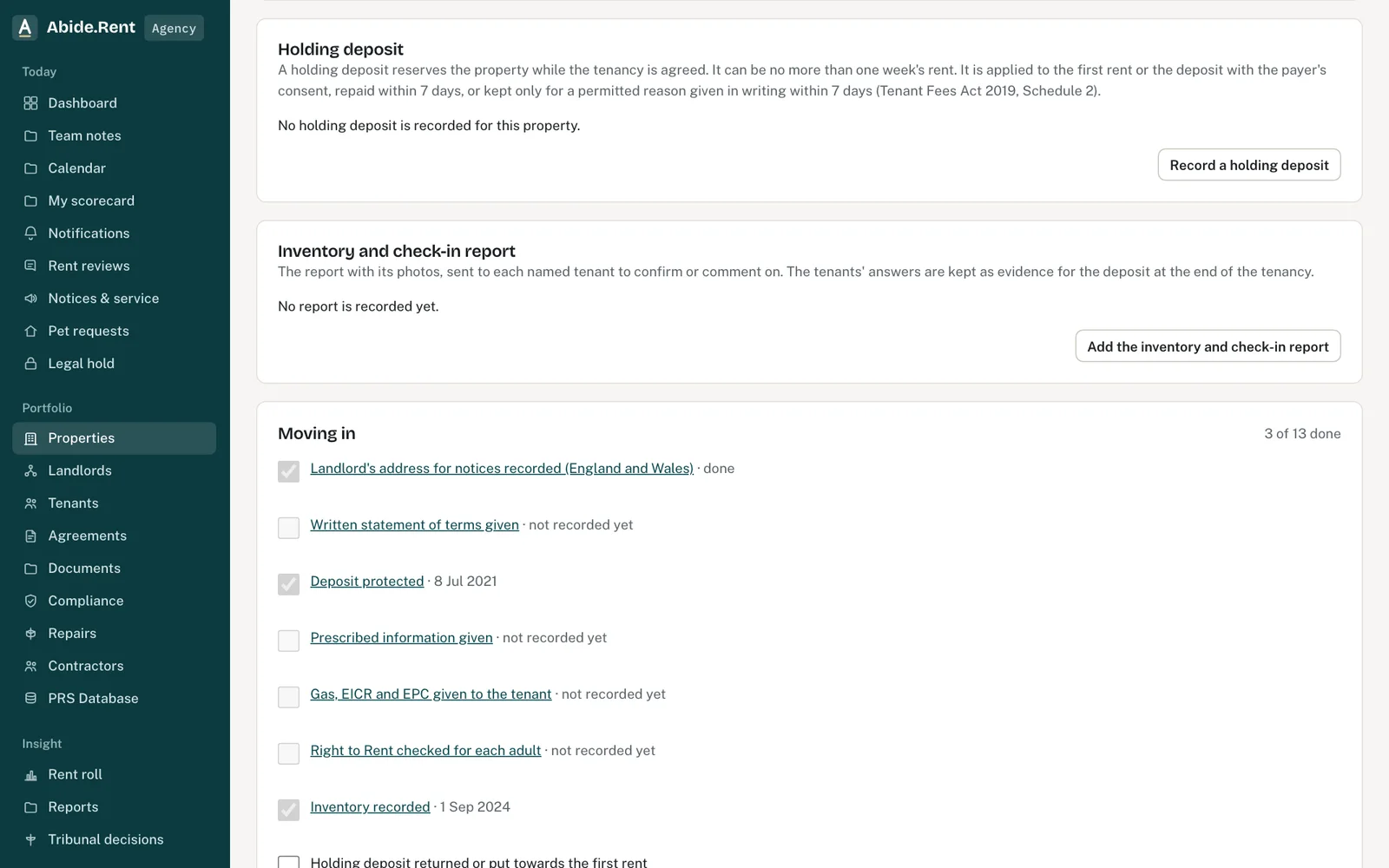
Moving in: every step, with what is still open.
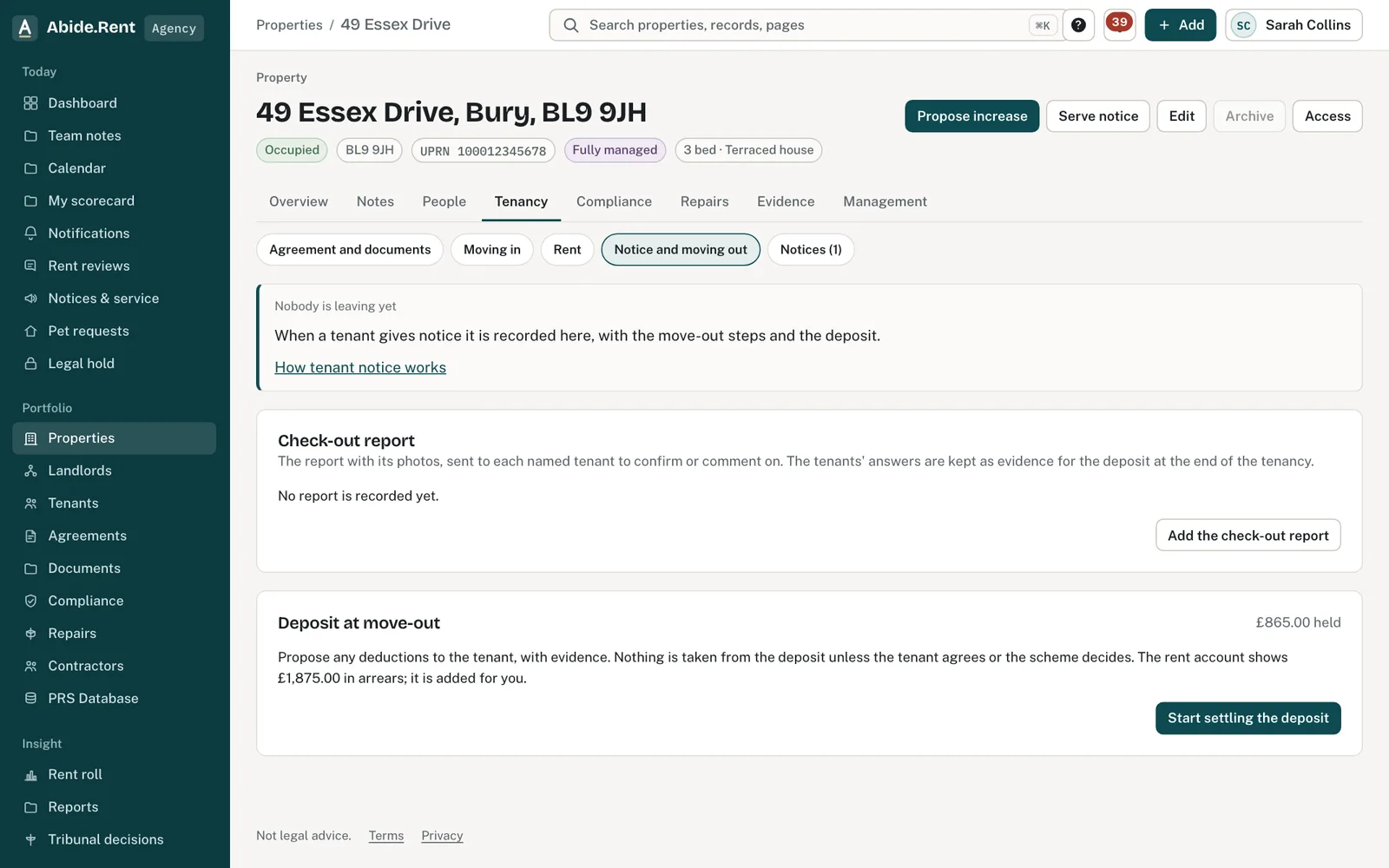
Moving out: add the check-out report and settle the deposit.
What you are deciding
Whether everything that should be on record is there before the tenancy starts, and what, if anything, comes out of the deposit at the end.
Your options
- Sign off the list. The landlord side signs the list as it stands. Steps still open need a note saying why. The tenant is then asked to confirm it.
- Settle the deposit. Propose deductions with evidence. The tenant agrees or disputes each one; nothing is taken without agreement or the scheme's decision.
- Return it in full. Send a proposal with no deductions. The tenant confirms, and the release is recorded.
How to do it
- Record the landlord's address for notices on the landlord's page. It must be in England or Wales. Move-in sign-off waits for it.
- Work through Moving in. Steps that are records elsewhere tick themselves; tick the rest as they are done.
- Select Sign off moving in. The tenant confirms the list, or says what is not right, from their portal.
- At the end, ask each tenant for a forwarding address, and record the check-out inspection.
- In Deposit at move-out, select Start settling the deposit. Any rent arrears are added from the rent account.
- Add each other deduction with its details and evidence, then Send to the tenant.
- When the tenant agrees, release the money through the scheme within 10 days and select Record the release. If they dispute, revise and send again, or refer it to the scheme and record its decision.
What must be on record
- The landlord's address for notices in England or Wales: on the written statement, on rent demands (Landlord and Tenant Act 1987, sections 47 and 48) and in the deposit prescribed information.
- Each tenant's contact address for the end of the tenancy: the deposit prescribed information asks for it.
- A relevant person: anyone other than the tenant who paid the deposit, such as a parent or a council scheme, with their address and contact details.
What a sign-off records
Each sign-off keeps the list exactly as it stood, with a fingerprint (a SHA-256 hash). If a step changes afterwards, the list says so until it is signed again, and the tenant is asked to confirm the new list.
When the tenant gives notice
The notice is the first step of moving out: its end date is the move-out date every other step works towards. The landlord side should acknowledge it (the agency on fully managed homes, the landlord on let-only and rent collection); if nobody has after seven days, Abide.Rent reminds them. A notice can only be withdrawn if both sides agree. If the end date passes and the tenancy is still open, Abide.Rent says so: record the move-out if they have gone, and take legal advice if they are still there.
The deposit
The money moves through the deposit scheme. Abide.Rent records what was proposed, what the tenant answered, the dates and the split. Anything claimed beyond the deposit, such as arrears larger than it, is shown separately: it is a debt to recover, not something the deposit can cover.
A worked example
On Monday 12 October 2026 an agent starts settling a deposit. The rent account shows half a month's rent in arrears, which is added for them. They add a cleaning charge with the invoice and send it. The tenant agrees both on Tuesday 13 October, so the release date is Friday 23 October. The agent releases the money through the scheme and records the split; the deposit is marked "Returned with agreed deductions".
What Abide.Rent does for you
- Ticks move-in and move-out steps from the records they come from.
- Keeps every sign-off, answer and release with the date and who did it, and emails each side.
- Reminds the tenant before the answer date, and the agency before the release date.
If something goes wrong
- “That step is completed from your records, not by ticking it.”
What to do: Record the thing itself (the deposit, the Right to Rent check) and the step ticks. - “Choose the result of the check: right to rent confirmed, time-limited, or no right to rent shown.”
What to do: Pick the result of each Right to Rent check. - “Why are … steps still open?”
What to do: Abide.Rent asks for a reason before signing off moving in with steps open. Write it, or finish the steps. - “Add a named tenant to the tenancy before proposing deductions.”
What to do: Deductions go to named tenants: add them first. - “Only the landlord, or the agent recording the landlord's written approval, can approve these deductions.”
What to do: Ask the landlord to approve, or record their written approval.
Common mistakes
- Taking a deduction because it seems fair. Without the tenant's agreement or the scheme's decision it is not yours to keep.
- Asking for professional cleaning. You can ask for the home back as clean as it started; requiring a paid cleaner is not allowed.
- Signing off move-in before the landlord's address for notices is recorded. Abide.Rent will not let you.
What to do next
More in Properties and tenancies
 Add a tenancy and joint tenantsRecord who lives in a property, the rent and the start date. Add joint tenants, permitted occupiers and guarantors to the same tenancy.
 Damp, mould and emergencies: Awaab's Law stages (proposed)Choose to work to the Awaab's Law timescales on damp, mould and emergency repairs. They apply to social housing; for private renting they are proposed, not law yet.
 Is it fixed? The tenant's answer on a repairWhen you mark a repair fixed, the tenant is asked whether it is. A yes is recorded; still a problem opens it again.