Ground 8 is the possession ground for serious rent arrears. The threshold depends on how often rent is paid.
Who this is for: letting agencies and landlords.
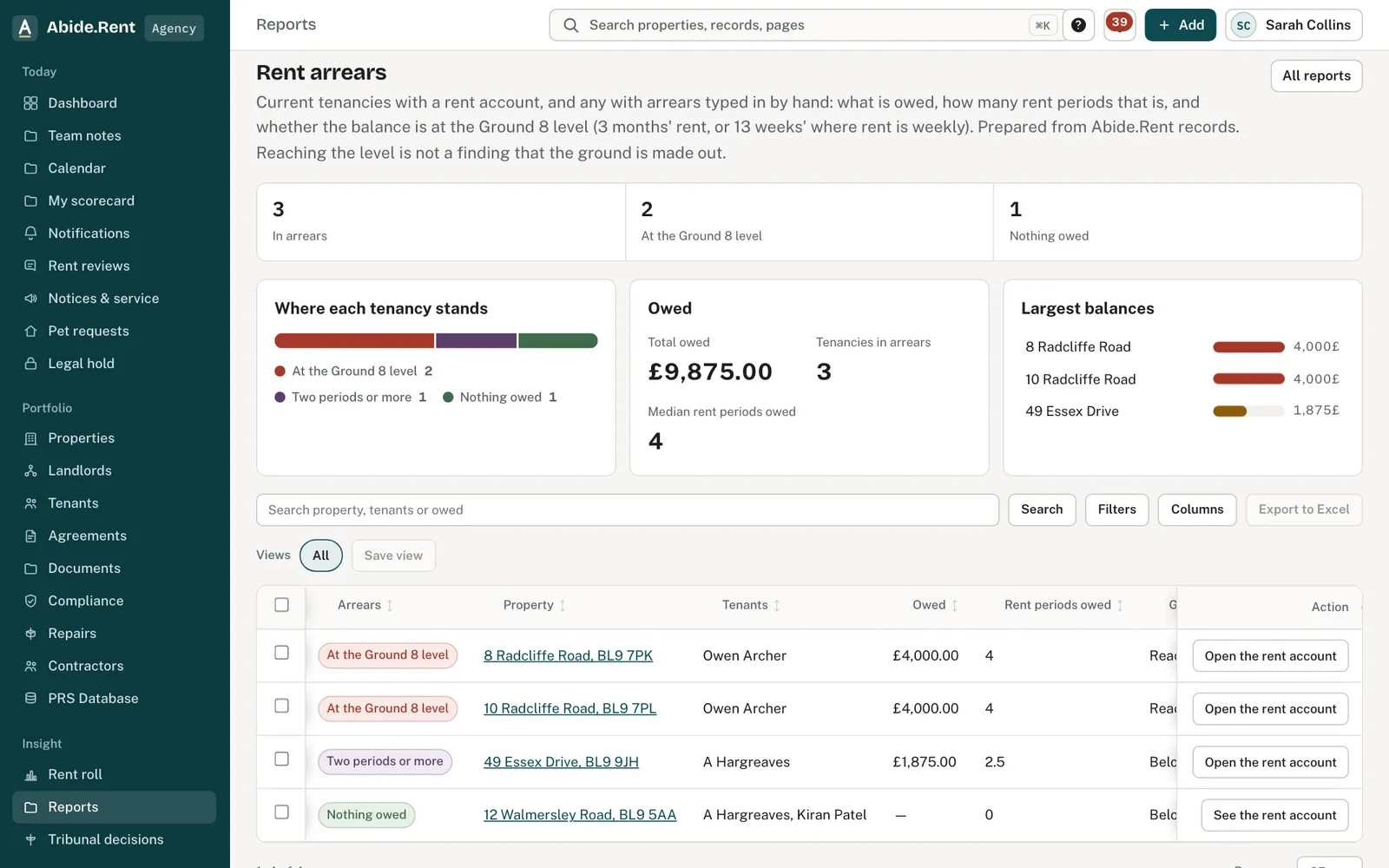
Rent arrears: amount, periods owed and the Ground 8 threshold.
What you are deciding
Whether the arrears you have recorded meet the threshold for the way this rent is paid.
Your options
- Rent paid monthly. At least 3 months' rent unpaid.
- Rent paid weekly. At least 13 weeks' rent unpaid.
- Notice. Four weeks, whichever way the rent is paid.
- Below the threshold. Ground 8 is shown as not available. Other arrears grounds have their own tests.
How to do it
- Open the property and record the arrears on the tenancy, with the date each amount fell due.
- Generate a Section 8 notice and choose Ground 8.
- Abide.Rent compares the arrears you have recorded with the threshold and tells you whether it is met.
A worked example
Monthly rent of £950.00: the threshold is £2,850.00, 3 months' rent. A tenant who owes £2,850.00 on Monday 9 November 2026 meets it; one who owes £2,400.00 does not. Weekly rent of £220.00: the threshold is £2,860.00, 13 weeks' rent. A notice on Ground 8 alone, served by hand on Monday 9 November 2026, gives Monday 7 December 2026 as the earliest date for proceedings, four weeks on.
What Abide.Rent does for you
- Compares the arrears you enter with the threshold for the tenancy's rent frequency.
- Takes off a pending Universal Credit housing payment, if you record one, before measuring the arrears against the threshold, and says so in the result.
- Shows the ground as not available where the threshold is not met.
If something goes wrong
- “Ground 8 needs at least … in arrears”
What to do: The arrears are below the level. Check the rent account. - “Abide.Rent does not measure Ground 8 for … rent. Ask a solicitor how the threshold applies.”
What to do: Take advice for that rent frequency.
Common mistakes
- Counting two months' arrears as enough. The threshold is 3 months.
- Applying the monthly test to a weekly rent.
- Treating the comparison as the outcome. Whether the ground is made out on the day of a hearing is for the court.
What to do next
Keep reading
All help articlesMore in Notices
 Bring past notices and dates onto the recordRecord a notice you served before you used Abide.Rent, a safety record you gave the tenant on paper, or a request received long ago, each with the day it really happened.
 Following a tribunal referralFrom the tenant's application to the decision: record the directions, prepare and send your statement, and keep track of an inspection or hearing.
 Record how a notice was servedRecord the method, the date and any tracking reference. Abide.Rent works out the date a posted notice counts as served.