Using tribunal decisions to sense-check a proposed rent
Published tribunal decisions show how proposed increases have fared when challenged. Use them to judge risk, not to set the price.
- Reviewed
- Read
- 3 min
Abide.Rent holds the published market-rent decisions of the First-tier Tribunal. You can read them under Tribunal decisions and see them summarised by postcode district under Area statistics.
Who this is for: letting agencies and landlords.
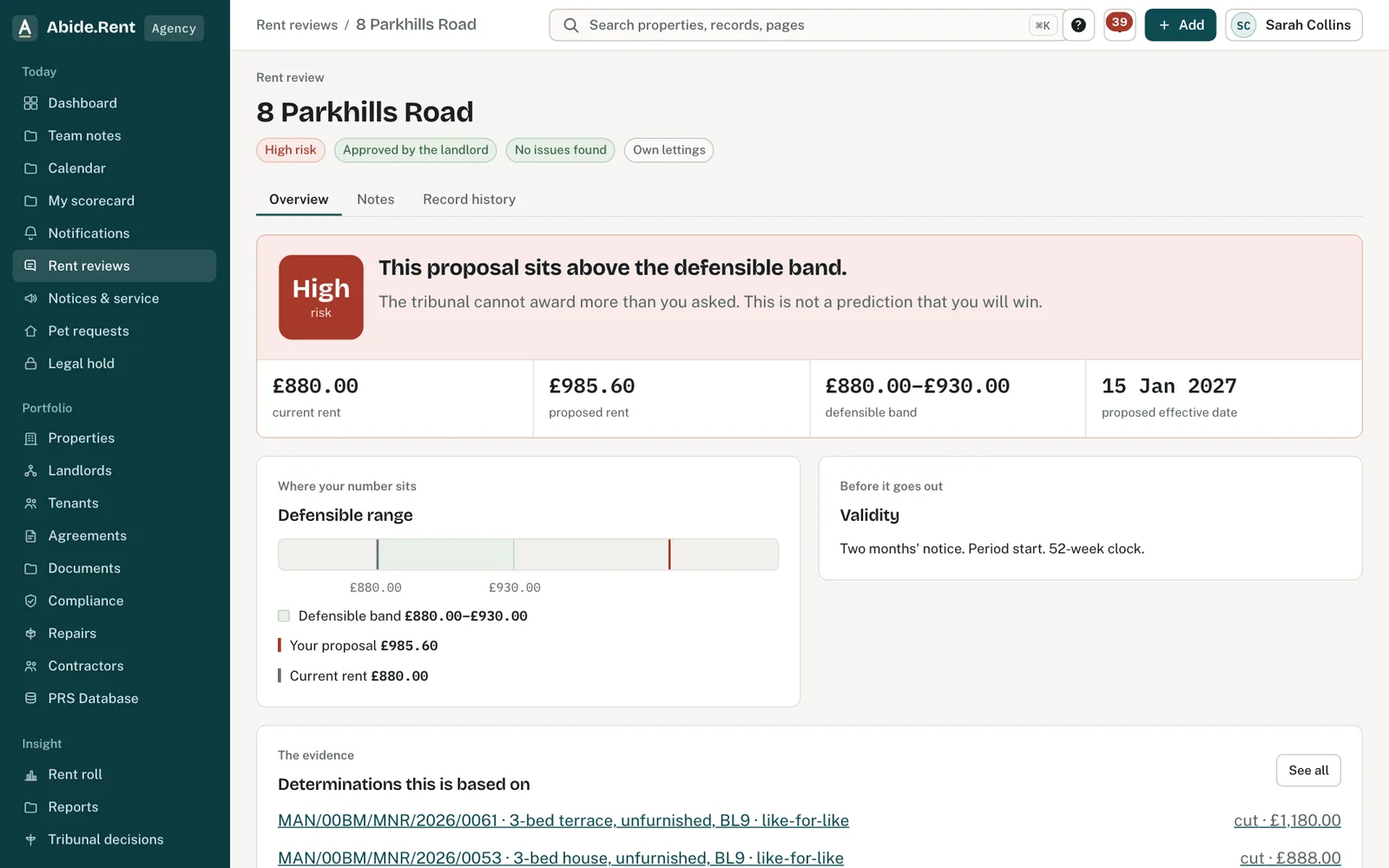
A proposal above the defensible band.
What you are deciding
How much weight to put on your own lettings, and how much on published decisions, when you set a figure.
Your options
- Price from your own recent lettings. This is the evidence a figure rests on. Rents you have achieved for similar properties nearby are the strongest support you have.
- Check the figure against tribunal decisions. They show how proposals like yours fared when challenged. Use them to judge risk.
- Price from tribunal decisions alone. Not reliable. There are too few decisions in most areas to price a rent from them.
How to do it
- Open Tribunal decisions and search by postcode district or property type.
- Open a decision to read the figures and download the published document.
- Open Area statistics for the district to see the decisions summarised.
- When you start a rent review, the nearest decisions are shown beside your proposed figure.
What the decisions tell you
- How often the tribunal set a rent below the one proposed. In the decisions published since the Act came into force, 60% were set below the proposal, and the typical reduction was 5%.
- How long a challenge takes. The typical wait is 82 days, and 84 days in London.
Source: Abide.Rent analysis of 846 First-tier Tribunal market-rent decisions published 1 March–12 October 2026 (outcomes: decisions under the Renters' Rights Act rules; waits: all 2026 decisions), as of 12 October 2026.
Contains public sector information licensed under the Open Government Licence v3.0.
A worked example
On Tuesday 27 October 2026 an agent is deciding between £1,325.00 and £1,400.00 for a flat let at £1,250.00. Her own three recent lettings nearby run from £1,290.00 to £1,340.00. The district has two published decisions; in both the tribunal set a rent below the proposal. She proposes £1,325.00: it sits inside her own range, and if the tenant refers it she has three achieved rents to show. At £1,400.00 she would have none, and the typical wait of 82 days would pass before any new rent began.
What Abide.Rent does for you
- Shows the nearest published decisions beside your figure.
- Summarises decisions by postcode district.
- Keeps the evidence you relied on with the review.
If something goes wrong
- “A proposal that is too high cannot be rescued at tribunal.”
What to do: Bring the figure into the range before approval. - No decisions are listed for your home
What to do: There are none like-for-like nearby. The risk comes from local rents only.
Common mistakes
- Treating a tribunal decision in another district as a comparable.
- Reading the share of reduced proposals as a forecast for your own. It describes past decisions.
- Leaving your own lettings out of the review. They are the evidence.
What to do next
More in Rent reviews
 What the tribunal can and cannot doThe tribunal decides the market rent. It cannot set more than the landlord proposed, cannot backdate, and can delay the start for hardship.
 Area statistics and tribunal decisionsArea statistics show what tribunals did in each postcode district. The decisions list holds every published decision. Both show risk, not a rent.
 How the rent range is worked outEach rent review shows a defensible range for the home, and where your proposal sits against it, with the evidence behind it.