A tenant leaving: notice, move-out and the deposit
From the tenant's notice to the deposit being returned: the dates, who does what, and the reminders.
- Reviewed
- Read
- 3 min
A tenant ends a periodic tenancy by giving notice in writing. This guide follows the tenancy from that notice to the deposit being returned.
Who this is for: letting agencies, landlords and tenants.
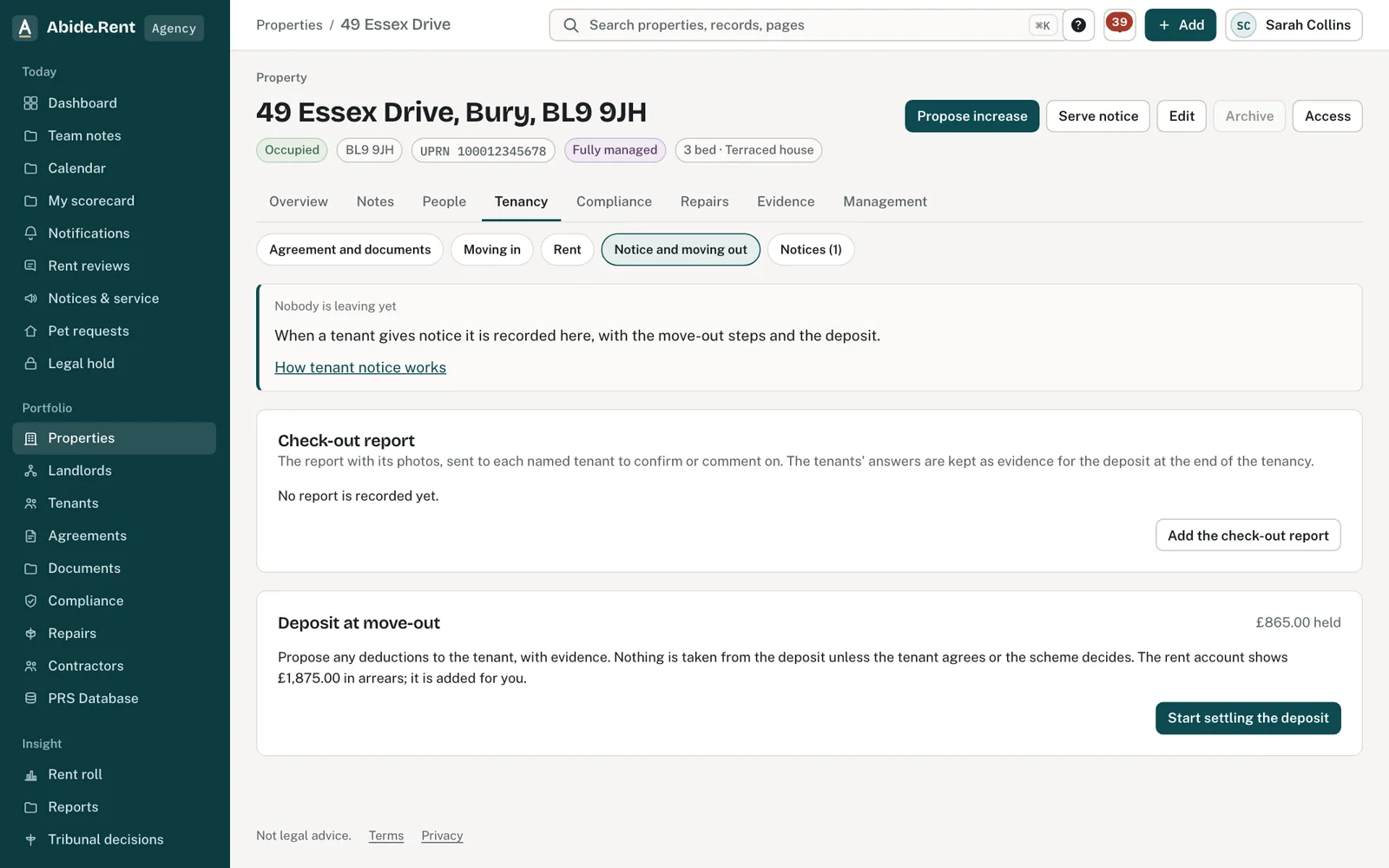
The tenant's notice, the move-out list and the deposit settlement.
What you are deciding
For the tenant: the end date. For the landlord side: what, if anything, comes out of the deposit.
Your options
- At least two months' notice. The tenancy ends on the date given, which should be a rent day or the day before one, at least two months away.
- Shorter notice. Only if the landlord agrees in writing. On a joint tenancy every named tenant must be party to that agreement as well.
- One joint tenant gives notice. It ends the tenancy for every tenant and occupier, not just the one who gave it.
The journey at a glance
| When | Step | Who | The law |
|---|---|---|---|
| Notice given | Notice in writing, in the portal or on paper | Tenant | Protection from Eviction Act 1977 s.5 |
| Straight away | Acknowledgement with the end date, sent to every tenant and the landlord | Landlord side | — |
| Before the end date | Move-out checklist; forwarding addresses; check-out booked | Both sides | — |
| The end date | Check-out against the inventory | Landlord side | — |
| After check-out | Deductions proposed with evidence; each tenant agrees or disputes each one | Landlord side; tenants answer | Deposit scheme rules |
| Within 10 days of agreement | Deposit released through the scheme | Landlord side | Deposit scheme rules |
| If disputed | Referred to the scheme's free dispute service | Either side | Housing Act 2004 |
What each party does
Tenant
- Give notice in your portal under Leaving, choosing an end date Abide.Rent accepts.
- Agree the move-out checklist and give a forwarding address.
- Answer each proposed deduction: agree, or dispute with your reason.
Letting agency or landlord
- Check the notice and its end date. Record a notice received on paper or by email with a copy of it.
- If the landlord agrees a shorter date, record the written agreement; on a joint tenancy confirm every named tenant is party to it.
- Do the check-out, propose deductions with evidence, and release the deposit through the scheme within 10 days of agreement.
When Abide.Rent reminds whom
- The landlord side, and the tenants for information: 30, 14, 7 and 1 days before, on the day, then 1, 7 and 14 days late the end date.
- An incoming tenancy's start date is reminded on the same days, so a back-to-back let is not missed.
A worked example
Rent is due on the 15th. On Thursday 5 November 2026 Kiran gives notice on a joint tenancy with Sam. The earliest end date Abide.Rent accepts is Thursday 14 January 2027, the day before a rent day more than two months away, and it ends the tenancy for both. Reminders go on Tuesday 15 December, Thursday 31 December, Thursday 7 January, Wednesday 13 January and Thursday 14 January 2027. Deductions of £135.00 are proposed on Monday 18 January; both tenants agree on Thursday 21 January, and the deposit is released by Sunday 31 January 2027.
What Abide.Rent does for you
- Works out the earliest valid end date and refuses one that is too soon.
- Applies one joint tenant's notice to the whole tenancy, and tells every tenant.
- Takes nothing from the deposit without the tenants' agreement or the scheme's decision.
If something goes wrong
- “The end date is too soon.”
What to do: Choose a date at least two months away that is a rent day or the day before one, or record the landlord's written agreement to a shorter date. - One joint tenant wants to stay
What to do: One joint tenant's notice ends the tenancy for everyone. Those who want to stay need a new tenancy agreed with the landlord.
Common mistakes
- Accepting an earlier date agreed by the tenants alone. A shorter notice needs the landlord's written agreement.
- Releasing the deposit before every joint tenant has answered.
What to do next
More in How it works
 Rent arrears and a Section 8 noticeFrom the first unpaid rent to the earliest date for court: the Ground 8 threshold, Form 3A, notice periods and the reminders.
 A new tenancy, from holding deposit to day 30Every step before and just after a tenant moves in: what the agency or landlord does, what the tenant gets, and the legal date for each.
 A pet request, from asking to the written answerThe tenant asks, the landlord side answers in writing within 28 days, or asks for more information first.